Morganza Spillway Opening Delayed Again Officials Say
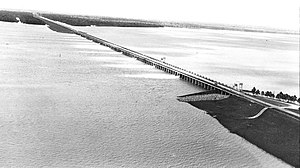
The Morganza Spillway, between the Mississippi River and the Atchafalaya Bowl, shown while open in 1973. Water flows from the Mississippi (upper right) into the Morganza Floodway (lower left).
The Morganza Spillway or Morganza Command Structure is a alluvion-control structure in the U.South. state of Louisiana. It is located along the western banking concern of the Lower Mississippi River at river mile 280, near Morganza in Pointe Coupee Parish. The spillway stands between the Mississippi and the Morganza Floodway, which leads to the Atchafalaya Basin and the Atchafalaya River in south-central Louisiana. Its purpose is to divert water from the Mississippi River during major overflowing events by flooding the Atchafalaya Basin, including the Atchafalaya River and the Atchafalaya Swamp. The spillway and side by side levees also aid prevent the Mississippi from changing its present course through the major port cities of Baton Rouge and New Orleans to a new course down the Atchafalaya River to the Gulf of United mexican states. The Morganza Spillway, operated by the U.South. Army Corps of Engineers, was opened during the 1973 and 2011 Mississippi River floods.[1] [2] [iii] [iv] [5]
History [edit]
The Great Mississippi Inundation of 1927 was the most destructive river flood in the history of the United States.[half-dozen] This was in big office due to the Mississippi River swelling to eighty miles (130 km) wide in spots.[7] To prevent a repeat of the Dandy Alluvion of 1927, and to have better control over river flooding in general, Congress passed the Flood Control Human action of 1928. This authorized the United states of america Army Corps of Engineers to build the Bonnet Carre Spillway,[note i] the Birds Bespeak floodway in Missouri, and the Morganza Floodway as role of the 1928 Mississippi River and Tributaries Project.[vii]

I of the 125 gates on the tail bay side of the Morganza Floodway.
Construction of the levees that make up office of the Morganza Spillway began in the tardily 1930s. The Morganza Command Construction portion of the project was completed in 1954.[vii] It later became incorporated into the Mississippi River Commission'southward 1956 project design flood,[ix] which added the Old River Command Construction (ORCS) in 1963 to the protections used to prevent Mississippi River flood.[ten] The Flood Command Human activity of 1965 provided farther regulation over the Morganza Spillway's office in Mississippi River flood prevention. A concrete pit called a stilling basin was added at the Morganza Spillway in 1977 "to provide erosion protection after the velocity of water pouring through the open bays during a 1973 flood caused severe scouring of the land backside the bays."[11]
Design and construction [edit]
The Morganza Spillway, a 4,159-human foot (1,268 thou) controlled spillway using a set of alluvion gates to control the volume of water entering the Morganza Floodway from the Mississippi River, consists of a physical weir, two sluice gates, seventeen scour indicators, and 125 gated openings which can allow up to 600,000 cubic anxiety per second (17,000 cubic metres per 2d) of water to be diverted from the Mississippi River into the Atchafalaya Basin during major floods. The project was completed in 1954.
A highway (Louisiana Route 1) and the Kansas Metropolis Southern Railway cross the construction.
The Corps of Engineers maintains the structures and, in times of flood, monitors their piers for scouring and stability. The Corps of Engineers has two 25-ton cranes used to elevator and lower the flood gates. The cranes gyre on special tracks next to the roadway, enabling the operators to open or shut whatsoever spillway gate or perform maintenance while the roadway is in utilise.
Operation during floods [edit]
The country on both sides of the Morganza Command Structure is to a higher place normal river h2o levels, and usually dry. In guild for h2o to reach the spillway, the Mississippi must kickoff rise well above its inundation stage, overtopping its banks. The Corps of Engineers considers opening the Morganza Spillway when the catamenia of the Mississippi at Red River Landing, Louisiana,[12] [13] is greater than ane,500,000 cu ft/south (42,000 grand3/s) and ascension.[1]
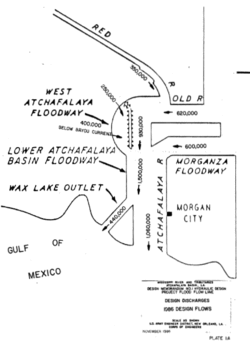
A diagram that depicts river flows period through the Morganza Spillway to the Cerise and Atchafalaya Rivers associated with a project design inundation, which is the hypothetical "maximum likely" flood of the Mississippi River, as estimated by the Corps of Engineers. The water aqueduct menstruum rates are listed in cubic feet per second.
H2o from the Mississippi is normally diverted into the Atchafalaya Basin at only one place, the Quondam River Control Structure (ORCS), in utilise since 1963, where floodgates are routinely used to redirect the Mississippi's catamenia into the Atchafalaya River such that the volume of the 2 rivers is dissever 70%/30%, respectively, as measured at the breadth of Red River Landing. During the 1973 Mississippi overflowing, the ORCS was being damaged due to high flow rates, leading to the opening of the Morganza Spillway to help relieve this pressure. Subsequently, the nearby Old River Control Auxiliary Structure (ORCAS) was constructed, adding additional floodgates for use during major floods.
The Morganza Spillway, virtually 30 miles (48 km) downriver from ORCS and ORCAS, is designed for emergency use to divert additional h2o from the Mississippi River into the Morganza floodway, which merges downstream with the Atchafalaya floodway earlier entering the Gulf. Diversion of water from the Mississippi's chief aqueduct has the effect of lowering water level in the Mississippi downstream of the spillway, helping to relieve stress on levees and other overflowing control structures both upstream and downward. As well controlling flooding in a given event, the system is also designed to prevent the Mississippi River from permanently altering course downwardly the Atchafalaya River, bypassing Baton Rouge and New Orleans.[i] [2] [3] [four]
Water that passes the Morganza Spillway first enters the Morganza Floodway, which extends from the spillway at the Mississippi River s to the E Atchafalaya River levee. The floodway, 20 miles (32 km) long and 5 miles (viii.0 km) wide, includes a stilling bowl, an approach channel, an outlet aqueduct, and two guide levees.[1] From at that place, diverted water enters the Atchafalaya River Basin Floodway near Krotz Springs, Louisiana,[1] and continues to the Gulf of United mexican states.
In an extreme flood event, a major release of water from the Morganza Spillway into the Morganza Floodway and Atchafalaya Basin inundates not only the floodways themselves (between their levees), only extensive additional areas of southern Louisiana throughout the Atchafalaya Bowl. In such an consequence, the water level of the Mississippi, high enough to overtop the Spillway, would already exist flooding some areas in the Basin downstream of the spillway, due to increased period through the ORCS and the ORCAS, as well as possible overtopping of levees nearly the spillway.[fourteen] This flooding, plus any additional water from a Morganza Spillway release, together decide the total extent of flooding throughout the Atchafalaya Basin during a major Mississippi River overflowing.
At hazard in the Atchafalaya Bowl are Morgan City (population 13,500), various smaller populated places, many farms, thousands of oil and gas wells, and considerable swampland. Inhabitants know that the region is a natural floodplain, and the Corps of Engineers issues written notices annually to all interests reminding them of the possibility that it might open the spillway and inundation the surface area. Whatsoever decision to open the spillway must be advisedly planned to give ample warning and protect life and belongings. Part of that planning process includes the Corps' preparation of maps known every bit "inundation scenarios" so that interested parties tin discuss how much water, if whatever, should be immune through the spillway.[i] [15] [sixteen] [17] [18] [19] [20] [21] [22]
During both moderate and severe floods of the Mississippi, the Bonnet Carré Spillway can likewise be opened to help protect New Orleans, many parts of which are below body of water level. The Bonnet Carré Spillway, built afterward the Great Mississippi Inundation of 1927, is located well downstream of Morganza, where the Mississippi River approaches Lake Pontchartrain nigh New Orleans. The Corps uses Bonnet Carré to divert floodwaters into the lake in order to protect the levees near New Orleans.
Integrity of the Morganza Spillway, the Sometime River Control Structure, and nearby levees is essential to forbid the Mississippi from diverting its main aqueduct into the Atchafalaya Basin.[23]
Inundation events and the Morganza Spillway [edit]
Since its completion in 1954, the Morganza Spillway has been opened twice, in 1973 and 2011. The Morganza Spillway was also considered for opening during other major floods of the Lower Mississippi River.
Outset opening of gates (1973) [edit]
On April 17, 1973, in order to lower the water level of the Mississippi River and relieve pressure on the Former River Control Structure, the Corps of Engineers opened 42 of the 125 steel gates of the Morganza Spillway for the first time since its completion, allowing nearly half of its maximum designed flowrate to laissez passer from the Mississippi into the Atchafalaya Basin. The spillway received pocket-size scouring and slight damage to the stilling basin, and substantial flooding occurred in the Atchafalaya Basin. After the 1973 flood, the structure was restored to its original condition.[1] [three] [24]
Gates left closed in floods of 1983, 1993, 1997, 2008, and 2016 [edit]
The effect of opening the gates to go along the Mississippi in its electric current place was next raised in May 1983.[26] Although the gates were not opened, Louisiana Highway 1 running beyond the spillway was closed, and the Corps of Engineers built a 12-foot (3.7 m) ring dike and put a blanket of world across a section of the spillway to incorporate water pouring underneath information technology.[27]
During the Dandy Mississippi and Missouri Rivers Flood in 1993, officials decided to leave the gates of the Morganza Floodway closed.[28]
In March 1997, the river h2o flow at Billy Rouge reached 10,600,000 Usa gal (ane,420,000 cu ft) (40,000 m3) per 2nd.[29] Nonetheless, the catamenia charge per unit never reached the threshold of 11,200,000 Us gal (1,500,000 cu ft) (42,000 m3) per second for opening Morganza,[29] and residents of Sicily Island, Louisiana, became aroused that the spillway was not opened to foreclose flooding in their homes.[thirty] [31] [32]
In March–April 2008, officials considered only declined to open the spillway gates.[33] [34] While the spillway gates remained airtight then, flooding occurred in the Morganza forebay when the Mississippi River crested higher than the potato ridge levee at the forebay entrance. Local residents and National Baby-sit troops attempted to add height to the permanent levee by building a supplemental sandbag levee on elevation of it. All the same, additional rainfall raised the flood crest higher than even the supplemental sandbags, sending floodwaters over these levees into three,000 acres (one,200 ha) of cropland located within the floodway.[14] In the spring of 2016, the Corps considered opening the spillway but the forecast was lowered for the crest of the Mississippi River at Red River Landing, so the gates were left airtight.
2nd opening of gates (2011) [edit]
| Anticipated flood from Scenario one |
| Anticipated overflowing from Scenario 1a |
| Anticipated inundation from Scenario 2 |
| Predictable alluvion from Scenario 3 |


The 2011 Mississippi River floods began to get serious in April. In response, the Corps first analyzed the flooding, and then opened the spillway in a controlled style. The Corps studied iv flooding scenarios, all of which causeless the Bonnet Carré Spillway would be concurrently operating at full capacity (100%).
- Scenario ane: Open the Morganza Spillway to half (50%) of its maximum capacity, which would divert 300,000 cubic feet per second (viii,500 10003/s) of water.
- Scenario 1a: Open up the Morganza Spillway to i-quarter (25%) of its maximum capacity, which would divert 150,000 cubic feet per second (4,200 m3/due south) of water.
- Scenario two: Exercise not open the Morganza Spillway, and keep the Erstwhile River Control Structure (ORCS) at its routine operating level of only 30% of the Mississippi's flow; no additional h2o would exist diverted
- Scenario 3: Do not open the Morganza Spillway, and open the ORCS somewhat more than, which would divert an actress 150,000 cubic feet per second (4,200 miii/due south) of water.
Following this analysis, which showed that all-encompassing flooding was expected in the Atchafalaya Basin regardless of the choice made regarding the Morganza Spillway, the Corps decided to get-go the 2011 diversion by opening the spillway a bit less than described in scenario 1a (21%, not 25%)[36]
The Governor of Louisiana, Bobby Jindal, had meanwhile sent a letter on May 4, 2011, to Robert Gates, the United States Secretary of Defence, requesting that the National Guard be deployed under Championship 32 of the The states Code status to respond to tape water levels in Louisiana, where there was "a meaning probability that the U.S. Regular army Corps of Engineers [would] open up the Morganza Spillway for the get-go time since 1973."[37]
The second opening of the Morganza Spillway began with the lifting of a single floodgate on May fourteen, 2011. Diversion of 125,000 cubic feet per second (3,500 m3/southward) of h2o from the Mississippi River to the Atchafalaya Basin was planned during this event, with the structure operating at about 21% of its capacity. This diversion was deemed necessary to protect levees and preclude major flooding in Billy Rouge and New Orleans, with the tradeoff of creating perhaps severe flooding in the Atchafalaya Basin.[1] [38]
By May xviii, 2011, a full of 17 gates (the largest number for the 2011 outcome) had been opened by the Corps of Engineers. The Corps estimated the flow rate at 114,000 cu ft/s (3,200 mthree/due south). Nonetheless, on May 25, new estimates from the U.S. Geologic Survey (USGS) described a much college rate of 172,000 cu ft/due south (four,900 m3/s), resulting in the closure of 3 bays by May 26, and additional closures by May 29, bringing the total to eleven bays with an estimated diversion rate of 120,000 cu ft/s (3,400 one thousand3/s).[39] [xl] The Corps connected to evaluate the flow and close additional bays as appropriate. By June 6, the number of open gates had been reduced to seven,[41] and by June 8, just two gates were nonetheless open up.[40] All trophy were closed on July 7, 2011.
The Corps had estimated that it would take opening 1-4th of the spillway's 125 trophy — or 31 trophy — to control the catamenia of the river through Billy Rouge in response to a forecast crest of 45 feet (14 grand) anticipated on Tuesday, May 17, 2011, which must remain beneath ane,500,000 cu ft/s (42,000 grandthree/s) of h2o per second through Baton Rouge to ensure the integrity of the levee organisation.[42] Since Morganza never operated above 172,000 cu ft/s (4,900 mthree/s), the flooding in the Atchafalaya Bowl was considerably lower than had been anticipated during the initial estimates of 300,000 cu ft/s (8,500 chiliad3/due south).[39] Past May 29, the Corps had also opened 330 of the 350 bays of the Bonnet Carré Spillway located near New Orleans.[40]
-

Aerial photograph of the first bay opening on the Morganza Floodway on 14 May 2011. The Mississippi River is in the upper left groundwork, and the Atchafalaya Floodway to the right.
-

Water travel time down the Morganza Floodway after the May 14, 2011 opening.
-

Natural-colour satellite paradigm of the Floodway on May 15, 2011.
-

False colour satellite image of the Floodway on May 15, 2011.
Third opening of gates (2019; cancelled) [edit]
On Wednesday May 22, 2019, the U.South. Army Corps of Engineers appear that due to the extended inundation event on the Mississippi River, which had been in a higher place flood phase since January 2019, they were anticipating the tertiary opening of the Morganza Spillway. An anticipated further river rise stoked fears that the Mississippi River waters would overtop the spillway, which would destroy the structure. The possible opening could happen as early on as June ii, 2019. On Monday May 27, 2019, the Army Corps of Engineers officially announced it would open Morganza on Sunday, June ii, 2019.[43]
However, the US Army Corps of Engineers New Orleans issued a press release on May xxx, 2019, announcing the postponement of the opening of the Morganza Spillway until June half-dozen, 2019; ultimately the spillway was never opened in 2019. [44] The opening was later postponed again to June 9, then indefinitely.[45] [46]
See also [edit]
- W Atchafalaya Floodway
- The "Atchafalaya" section of the book The Control of Nature by John McPhee. ISBN 0-374-12890-1.
Notes [edit]
- ^ Located 33 miles (53 km) above New Orleans and completed in 1931.[eight]
References [edit]
- ^ a b c d e f g h "Morganza Floodway". United states Army Corps of Engineers. Archived from the original on January 11, 2012. Retrieved 2011-05-08 .
- ^ a b "Louisiana OLD RIVER Command STRUCTURE and Mississippi river flood protection". America'due south Wetland Resource Center. Loyola University'south Center for Environmental Communication (LUCEC).
- ^ a b c Weeks, John A. "Morganza Floodway". Retrieved 2011-05-08 .
- ^ a b "Will the Mississippi River change its grade in 2011 to the crimson line?". Mappingsupport. Retrieved 2011-05-08 .
- ^ Matt Scallan (March 16, 2008). "Corps does dry out run for river flooding. Drill gets agencies to piece of work together". The Times-Picayune. p. ane.
- ^ Man 5. Nature, National Geographic, May 2001 Accessed June 14, 2008
- ^ a b c Paul Rioux (May 15, 2011). "Corps Opens Morganza. Water unleashed into Atchafalaya Bowl". The Times-Picayune . Retrieved May 15, 2011.
- ^ Matt Scallan (Apr 2, 2008). "Corps slogs through test run at spillway. Opening this year appears unlikely". The Times-Piddling. p. one. Retrieved May xv, 2011.
- ^ Steven Ward (April 28, 2008). "Mississippi projects shield human lives. Levees just part of alluvion control". The Abet (Louisiana). p. A1. Archived from the original on 2008-05-02. Retrieved May 15, 2011.
- ^ Mike Hasten (May half-dozen, 2011). "That h2o is on its mode". Alexandria Daily Town Talk. p. A1. Retrieved May 15, 2011. [ dead link ]
- ^ Pocket-sized v. United states of america [ dead link ] , United States Court of Appeals for the Fifth Circuit (No. 94-30493) (January 17, 1995).
- ^ "Mississippi River at Cherry River Landing (01120)". The states Army Corps of Engineers. May 7, 2011. Archived from the original on 27 September 2011. Retrieved 10 May 2011.
- ^ "Daily Land and Discharge Information - Water Control - New Orleans District". U.S. Regular army Corps of Engineers. Archived from the original on 2004-05-fourteen. Retrieved 10 May 2011.
- ^ a b Water Over the Levee in Louisiana: iii,000 acres of wheat acres injure Archived 2011-08-21 at the Wayback Automobile, Midsouth Farmer, April 8, 2008.
- ^ Schliefstein, Mark. "Record high river likely to require opening of Morganza Spillway adjacent week (May 4, 2011, revised May 9, 2011)". The Times-Picayune (New Orleans). Retrieved ten May 2011.
- ^ Schliefstein, Marker. "Morganza Spillway might be opened to ease swollen Mississippi River (May 8, 2011, revised May 9, 2011)". The Times-Little (New Orleans). Retrieved 10 May 2011.
- ^ Morganza Spillway expected to open before long Archived 2011-05-xiv at the Wayback Machine, The News Star: May 9, 2011, Mike Hasten
- ^ Gov. Jindal Asks Army Corps to Release Map Outlining Touch on of Possible Opening of Morganza Spillway, Says Country Continues to Prepare for Flooding, Baton Rouge Today: May 6, 2011. [ dead link ]
- ^ Vastag, Brian & Lisa Rein (May 12, 2011). "Trading one deluge for another? As panic rises with the Mississippi, engineers consider flooding farms to protect ii La. cities". The Washington Mail service. p. Pages A1 & A6.
- ^ Sullivan, Brian One thousand. & Leela Landress. "Morganza Spillway to open as river flow rises to threshold". Bloomberg Businessweek. Archived from the original on 2011-08-04. Retrieved fifteen May 2011.
- ^ Daniels, Ronald Joel (2006). On Risk and Disaster: Lessons from Hurricane Katrina. University of Pennsylvania Press. p. 44.
- ^ "Corps Releases Inundation Map". News Release. U.Southward. Army Corps of Engineers. seven May 2011. Archived from the original on 2011-07-29. Retrieved 10 May 2011.
- ^ see "Risk of major course change in the Lower Mississippi River" for further give-and-take
- ^ "Engineers Open Steel Gate of Morganza Spillway". New York Times. Apr xviii, 1973. p. 93.
- ^ Julia Cass (May 27, 1983). "Forth The Levee, The River Is Rising". Philadelphia Inquirer. p. A1.
- ^ United Press International (June 7, 1983). "Common cold Grips Midwest Every bit More Floods Swamp Texas, Salt Lake Urban center". Miami Herald. p. A4.
- ^ "The Flood Of 1993". The Times-Picayune. July 10, 1993. p. B6.
- ^ a b Chris Grayness (March 21, 1997). "Shipping Perilous, B.R. Levees Threatened". The Times-Little. p. A1.
- ^ Leslie Zganjar (March 21, 1997). "Home Not Flooded? Stay Out Of Shelter". Seattle Times. p. A8. Retrieved May 15, 2011.
- ^ Marker Schleifstein And Joan Treadway (March 22, 1997). "Using Morganza Endangers Business concern, Homes, Wild animals". The Times-Picayune. p. A1.
- ^ Rhonda Bell (March 23, 1997). "River Still Making Trouble Corps Snares Spillway Boater". The Times-Picayune. p. A1.
- ^ Melissa Sellers (April half-dozen, 2008). "Gov. Jindal Holds Press Conference To Give Update On Ascension Waters & Parishes In State Of Emergency With GOHSEP, Officials". US State News. Archived from the original on 2011-09-16. Retrieved May xv, 2011.
- ^ 1000. Hasten (April vii, 2008). "Country, federal officials bracing for continued high water". The Times (Shreveport). p. B05.
- ^ "The Mississippi River". United states of america Ground forces Corps of Engineers. 2011-05-09. Archived from the original on 2008-10-09. Retrieved 2011-05-12 .
- ^ Morganza Floodway opens to divert Mississippi River away from Baton Rouge, New Orleans | NOLA.com
- ^ "Governor Jindal Sends Letter of the alphabet To Dept. Of Defence Requesting National Guard". States News Service (released past the part of the governor of Louisiana). May 4, 2011. Archived from the original on 2012-03-fourteen. Retrieved May xv, 2011.
- ^ The Watchers - U.s. 2011 Great Alluvion: Morganza spillway virtually to open up
- ^ a b "Corps begins to close bays on Morganza Floodway". The states Army Corps of Engineers, Team New Orleans. May 26, 2011. Archived from the original on Baronial 12, 2011. Retrieved May 29, 2011.
- ^ a b c "Morganza Floodway Opening Pace: 2011". United states Army Corps of Engineers, Team New Orleans. May 29, 2011. Archived from the original on 2011-05-14. Retrieved May 29, 2011.
- ^ WAFB: Only 7 Bays Remain Open at Morganze Spillway
- ^ KENNEDY, KATIE (xv May 2011). "Planning for loftier water". The Advocate. Archived from the original on 2011-05-18. Retrieved 15 May 2011.
- ^ "USACE to operate Morganza Control Construction". New Orleans Commune . Retrieved 2019-05-29 .
- ^ "UPDATE: OPERATION OF THE MORGANZA FLOODWAY POSTPONED". New Orleans District . Retrieved 2019-07-10 .
- ^ "UPDATE: Operation OF THE MORGANZA FLOODWAY POSTPONED". New Orleans District . Retrieved 2019-07-x .
- ^ "UPDATE: OPERATION OF THE MORGANZA FLOODWAY POSTPONED". New Orleans Commune . Retrieved 2019-07-10 .
External links [edit]
- Morganza Spillway Fish Jumping through Gates
- For other images of the Morganza Control Structure in operation during the 2011 inundation, see the U.S. Regular army Corps of Engineers Flickr page.
Coordinates: 30°46′36″N 91°37′12″W / xxx.7766°N 91.6199°West / xxx.7766; -91.6199
Source: https://en.wikipedia.org/wiki/Morganza_Spillway
0 Response to "Morganza Spillway Opening Delayed Again Officials Say"
Post a Comment